
Starting a Crypto Business: Your Complete Guide to Success in 2026
Starting a crypto business opens doors to a revolutionary industry. Many entrepreneurs struggle with where to begin and what steps to take. The blockchain space moves fast, and mistakes can be costly.
But here’s the good news: you don’t need to be a tech genius to succeed.
This guide breaks down everything you need to know. You’ll discover how to validate your idea, secure funding, and build a loyal community. We’ll cover legal requirements, marketing strategies, and common pitfalls to avoid.
The crypto industry is growing rapidly. Global adoption is increasing every year. New opportunities emerge constantly for smart entrepreneurs who know how to navigate this space.
Whether you’re launching a DeFi platform, NFT marketplace, or crypto exchange, the fundamentals remain the same. You need a solid plan, the right team, and clear execution.
Let’s dive into the practical steps that will set you up for success.
Understanding the Crypto Business Landscape

The crypto market has matured significantly since Bitcoin’s early days. Today’s investors and users demand professionalism, security, and real utility.
What Makes Crypto Businesses Different
Traditional businesses operate in well-established frameworks. Crypto ventures face unique challenges that require different approaches.
Regulation changes constantly. What’s legal today might face restrictions tomorrow. You must stay informed about regulatory developments in your target markets.
Technology evolves rapidly. New blockchain protocols launch regularly. Competitors can emerge overnight with better solutions.
Community drives everything. Your users aren’t just customers—they’re stakeholders. They expect transparency, engagement, and voice in your project’s direction.
Global reach from day one. Unlike traditional startups, crypto businesses operate internationally immediately. This creates opportunities but also compliance complexities.
Current Market Trends
Several trends are reshaping the crypto landscape right now:
- Institutional adoption continues growing with major corporations exploring blockchain solutions
- Regulatory clarity is improving in key markets like the EU and Asia
- Real-world utility matters more than speculation
- Cross-chain solutions are becoming standard expectations
- Sustainability concerns influence project design and investor decisions
The days of launching tokens without purpose are over. Users want projects that solve real problems and deliver measurable value.
Validating Your Crypto Business Idea
Don’t build something nobody wants. Validation saves time, money, and heartbreak.
Identify a Real Problem
Every successful crypto business solves a specific problem. Ask yourself these questions:
What pain point are you addressing? Be specific. “Making payments easier” is too vague. “Reducing cross-border payment fees for freelancers by 80%” is concrete.
Who experiences this problem? Define your target audience clearly. Age, location, technical expertise, and current solutions they use all matter.
How do people solve this problem now? Understanding existing solutions helps you identify gaps and opportunities.
Research Your Competition
Competition validates market demand. Zero competitors might mean zero market interest.
Study similar projects carefully. What features do they offer? Where do users complain? What pricing models work?
Look beyond direct competitors. Traditional fintech companies and Web2 solutions targeting the same problem are also your competition.
Create a comparison chart of top competitors:
| Feature | Competitor A | Competitor B | Your Solution |
| Transaction Speed | 5 seconds | 10 seconds | 2 seconds |
| Fees | 2% | 1.5% | 0.8% |
| Supported Chains | 3 | 5 | 8 |
| User Interface | Complex | Moderate | Beginner-friendly |
This exercise reveals where you can differentiate and add value.
Test Before Building
Build a minimum viable product (MVP) quickly. Don’t wait for perfection.
Launch a simple version to early adopters. Gather feedback ruthlessly. Iterate based on real user behavior, not assumptions.
Consider these validation methods:
- Landing page tests measure interest before building
- Waitlist signups indicate market demand
- Beta programs provide crucial early feedback
- Community polls help prioritize features
Data beats opinions every time. Let user behavior guide your development roadmap.
Building Your Crypto Business Foundation
Strong foundations prevent future problems. Get these elements right from the start.
Assemble the Right Team
You can’t do everything alone. Crypto projects require diverse expertise.
Core team members you need:
- Blockchain developers who understand smart contracts and security
- Legal advisors familiar with crypto regulations
- Marketing specialists experienced in Web3 community building
- Business strategists who can plan sustainable growth
Don’t hire friends just because you know them. Skills and commitment matter more than personal relationships.
Consider outsourcing specialized tasks initially. Full-time hires come with significant costs. Contractors provide flexibility while you validate your model.
Choose Your Business Structure
Legal structure impacts everything from taxes to liability protection.
Common options include:
- LLC (Limited Liability Company) – Popular for crypto startups, offers liability protection
- Corporation – Better for raising venture capital, more complex structure
- DAO (Decentralized Autonomous Organization) – Experimental but growing in crypto space
- Foundation – Common for token-based projects, especially in crypto-friendly jurisdictions
Consult with lawyers experienced in crypto businesses. Generic business attorneys often lack necessary expertise. Similar to how PedroVazPaulo marketing consulting specializes in specific marketing strategies, you need specialized legal guidance.
Select Your Jurisdiction Carefully
Where you incorporate matters enormously in crypto. Different countries offer varying regulatory clarity and tax benefits.
Crypto-friendly jurisdictions:
- Switzerland – Clear regulations, established crypto valley
- Singapore – Progressive approach, strong business infrastructure
- UAE – Growing crypto hub, favorable tax environment
- Portugal – Tax advantages for crypto businesses
- Wyoming (USA) – Crypto-friendly state laws
Consider your target market too. Operating from one jurisdiction while serving another creates compliance challenges.
Securing Funding for Your Crypto Venture
Capital fuels growth. You’ll need money for development, marketing, legal compliance, and operations.
Funding Options Available
Multiple paths exist for raising capital in crypto. Each has pros and cons.
Angel Investors provide early-stage capital and mentorship. They typically invest smaller amounts but offer valuable connections and advice.
Venture Capital firms invest larger sums in exchange for equity. They expect rapid growth and clear exit strategies.
Token Sales (ICOs/IDOs) raise funds directly from community members. They require careful legal structuring and strong marketing.
Grants and Accelerators offer non-dilutive funding and support. Competition is fierce but worth pursuing.
Compare funding sources:
| Funding Type | Amount Range | Equity Required | Speed | Best For |
| Angel Investors | $50K-$500K | 10-20% | 1-3 months | Early validation |
| Venture Capital | $1M-$50M+ | 20-40% | 3-6 months | Scaling proven models |
| Token Sales | $500K-$100M+ | Varies | 2-6 months | Community-driven projects |
| Grants | $10K-$500K | 0% | 1-4 months | Open-source development |
Prepare Your Investment Materials
Investors see hundreds of pitches. Yours must stand out immediately.
Your pitch deck should include:
- Problem statement – What specific issue exists?
- Solution overview – How does your project solve it?
- Market opportunity – How big is the addressable market?
- Business model – How will you generate revenue?
- Traction metrics – What progress have you made?
- Team credentials – Why are you qualified to execute?
- Financial projections – What returns can investors expect?
- Funding needs – How much do you need and why?
Keep slides visual and concise. Investors want clarity, not complexity.
Demonstrate Traction
Traction proves your concept works. It dramatically increases funding success rates.
Show concrete evidence of progress:
- User numbers – How many people use your product?
- Revenue figures – What income have you generated?
- Partnership agreements – Who has committed to working with you?
- Media coverage – What validation have you received?
- Community size – How many followers and supporters do you have?
Even modest traction beats zero. A hundred active users prove more than a thousand signups with no engagement.
Navigating Legal and Regulatory Requirements
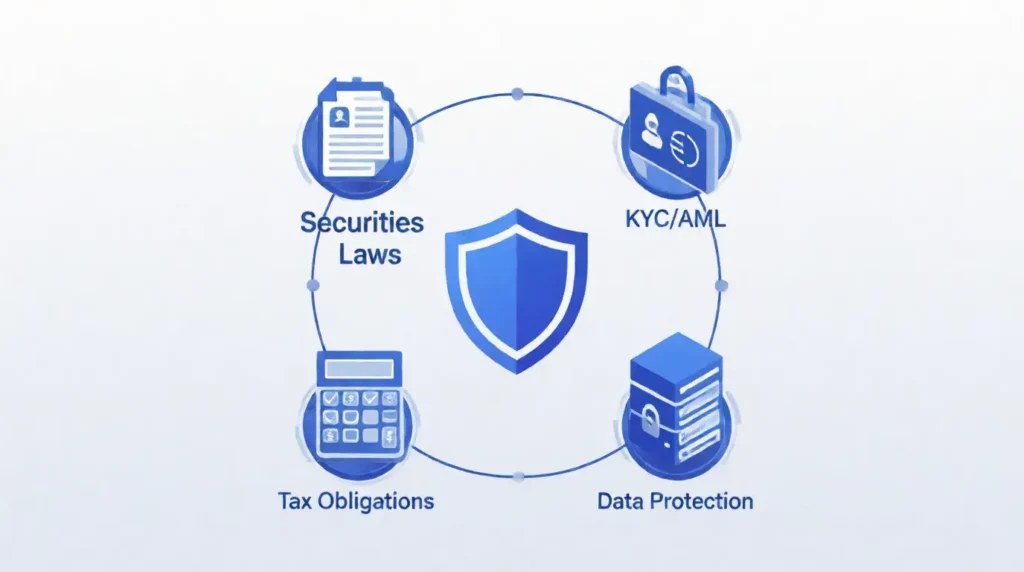
Compliance isn’t optional. Regulatory violations can shut down your business overnight.
Understand Your Regulatory Obligations
Crypto regulations vary dramatically by jurisdiction. What’s allowed in one country might be illegal in another.
Key regulatory areas:
Securities laws determine whether your token qualifies as a security. Securities face strict registration and disclosure requirements.
KYC/AML requirements mandate customer identification and anti-money laundering procedures. Most jurisdictions require these for crypto businesses.
Tax obligations include corporate taxes, transaction reporting, and potential VAT/sales tax on services.
Data protection rules like GDPR affect how you collect and store user information.
Work With Experienced Legal Counsel
Don’t cut corners on legal advice. Mistakes cost far more than proper guidance.
Find attorneys who specialize in crypto businesses. They understand the nuances that general business lawyers miss.
Budget for ongoing legal support. Regulations change frequently. One-time advice becomes outdated quickly.
Implement Compliance Systems Early
Build compliance into your operations from day one. Retrofitting compliance is expensive and risky.
Establish clear procedures for:
- Customer verification – How you confirm user identities
- Transaction monitoring – How you detect suspicious activity
- Record keeping – What data you store and for how long
- Regulatory reporting – How you submit required information
Use established compliance software when possible. Custom solutions often miss critical requirements.
Developing Your Crypto Product or Service
Great products solve real problems elegantly. Focus on user experience above everything else.
Start With an MVP
Don’t try to build everything at once. Launch with core features that deliver immediate value.
Your MVP should:
- Solve the primary problem clearly and effectively
- Work reliably without critical bugs or security issues
- Provide clear value that users recognize immediately
- Gather feedback through built-in mechanisms
Perfection is the enemy of progress. Launch quickly, learn fast, and iterate constantly.
Prioritize Security
Security breaches destroy crypto businesses. One hack can cost everything you’ve built.
Essential security measures:
- Smart contract audits from reputable firms before launch
- Penetration testing to identify vulnerabilities
- Bug bounty programs that incentivize security researchers
- Multi-signature wallets for company funds
- Regular security updates as new threats emerge
Budget significant resources for security. Cutting security costs is gambling with your business and users’ funds.
Design for Users, Not Developers
Most crypto products are too complex for mainstream adoption. Simplicity wins.
Your interface should make sense to someone’s grandmother. If it doesn’t, simplify further.
Test with real users outside crypto. Their confusion reveals improvement opportunities. Their “stupid questions” highlight unclear design.
Similar to how crypto payment integration must balance technical capability with user-friendliness, your entire product needs this balance.
Building and Growing Your Community
Community drives crypto success. Your users become your biggest advocates or harshest critics.
Start Building Before Launch
Don’t wait until your product is ready. Begin community building immediately.
Where to focus your efforts:
Twitter/X remains the primary platform for crypto discussions. Share development updates, industry insights, and engage with your audience daily.
Discord provides space for deeper community interaction. Create channels for different topics and user types.
Telegram works well for announcements and real-time updates. Many crypto users prefer it over other platforms.
LinkedIn helps reach institutional investors and enterprise clients. Professional credibility matters here.
Create Valuable Content
Content marketing establishes thought leadership and attracts organic traffic.
Content types that work:
- Educational threads explaining complex concepts simply
- Market analysis offering unique perspectives on trends
- Case studies demonstrating real-world impact
- AMAs (Ask Me Anything) building direct connections
- Video tutorials making your product accessible
Quality beats quantity always. One insightful article generates more value than ten mediocre posts.
Understand industry-specific cryptocurrencies to create relevant, targeted content for your niche.
Reward Early Supporters
Your first users take the biggest risk on you. Recognize and reward their faith.
Consider these incentive structures:
- Token airdrops for early community members
- Exclusive access to new features before public release
- Special roles in your Discord or community platforms
- Revenue sharing programs for active contributors
- Governance rights allowing input on project decisions
Loyalty programs create powerful network effects. Happy early users recruit new members organically.
Marketing Your Crypto Business Effectively

Marketing in crypto requires different approaches than traditional marketing. The community sniffs out inauthenticity instantly.
Focus on Education, Not Promotion
Crypto users are sophisticated and skeptical. Hard selling backfires spectacularly.
Instead, educate your audience about:
- The problem you’re solving and why it matters
- How your solution works in clear, simple terms
- The benefits users actually receive
- Your differentiators without trashing competitors
Value-first marketing builds trust. Trust converts better than any sales pitch.
Leverage Strategic Partnerships
Partnerships amplify your reach exponentially. The right collaborations open doors to established communities.
Partnership opportunities include:
- Influencer collaborations with respected crypto voices
- DAO partnerships that align with your mission
- Exchange listings that increase accessibility
- Protocol integrations that expand functionality
- Media partnerships for broader coverage
Choose partners whose values align with yours. Misaligned partnerships damage reputation quickly.
Track Metrics That Matter
Vanity metrics feel good but don’t drive business results. Focus on actionable data.
Key metrics to monitor:
- Active users (not just signups)
- Retention rates (how many users return)
- Transaction volume (actual usage)
- Cost per acquisition (marketing efficiency)
- Conversion rates (from visitor to user)
- Community engagement (quality of interactions)
Review metrics weekly. Adjust strategies based on what the data reveals, not what you hope is true.
Understanding choosing the right cryptocurrency helps you make informed decisions about which tokens to integrate or support in your ecosystem.
Managing Operations and Scaling
Operations make or break crypto businesses. Great ideas fail with poor execution.
Build Scalable Systems
Don’t create processes that only work at current size. Plan for 10x growth from day one.
Areas requiring scalable systems:
- Customer support – How will you help users when volume increases?
- Transaction processing – Can your infrastructure handle peak loads?
- Compliance monitoring – Will your KYC/AML systems scale?
- Financial management – Are your accounting processes automated?
Automation beats manual processes for everything except human judgment calls.
Manage Cash Flow Carefully
Crypto markets are volatile. Cash runway determines survival during downturns.
Financial management essentials:
- Maintain 12-18 months of operating expenses in stable assets
- Diversify treasury holdings across stablecoins and fiat
- Track burn rate weekly to spot problems early
- Plan for worst-case scenarios with contingency budgets
- Separate operating funds from long-term reserves
Many promising crypto businesses failed because they ran out of money, not ideas.
Stay Informed and Adaptable
The crypto industry evolves at breakneck speed. Yesterday’s best practices become tomorrow’s outdated approaches.
How to stay current:
- Follow industry news from credible sources daily
- Attend conferences and networking events regularly
- Join professional groups with other crypto founders
- Monitor competitor moves without obsessing over them
- Listen to user feedback consistently and seriously
Flexibility separates winners from losers. Be willing to pivot when data demands it.
Learning about crypto casino responsible gambling demonstrates the importance of ethical operations and user protection, principles that apply across all crypto businesses.
Common Mistakes to Avoid
Learning from others’ failures saves you time and money. These mistakes kill crypto businesses regularly.
Overcomplicating the Product
Complexity confuses users and slows development. Simple solutions win.
Don’t add features just because competitors have them. Focus ruthlessly on your core value proposition.
Every additional feature creates maintenance burden and potential failure points.
Ignoring Community Feedback
Your users see problems you miss. Dismissing their input is arrogant and costly.
Create clear feedback channels. Respond to concerns quickly. Show you’re listening through actions, not just words.
Even negative feedback provides valuable insights. Embrace criticism as free consulting.
Underestimating Regulatory Risks
“Move fast and break things” doesn’t work in regulated industries. Compliance violations have serious consequences.
Budget adequately for legal expenses. They’re investments in business survival, not optional costs.
Neglecting Security
One security breach can end your business. The reputational damage alone is often fatal.
Invest in security before marketing. Users will forgive slow feature development. They won’t forgive lost funds.
Poor Token Economics
If your project includes a token, its economics must make sense. Broken tokenomics lead to death spirals.
Token design considerations:
- Supply management – Inflation rates and token burns
- Utility – Real reasons to hold and use your token
- Distribution – Fair allocation without excessive concentration
- Incentives – Aligned interests between users and holders
Get expert input on token design. Mistakes here are nearly impossible to fix later.
Frequently Asked Questions
What’s the minimum capital needed for starting a crypto business?
You can start with $50,000-$100,000 for an MVP. Development costs typically range from $30,000-$80,000. Legal setup requires $10,000-$20,000. Marketing and operations need another $10,000-$30,000. Bootstrap initially, then raise larger amounts after validating your concept.
How long does it take to launch a crypto business?
Most crypto startups take 6-12 months from concept to launch. Planning and legal setup consume 2-3 months. MVP development requires 3-6 months. Community building should start immediately. Fundraising can happen in parallel. Complex projects may take 18-24 months.
Do I need blockchain development experience for starting a crypto business?
No, you don’t need technical expertise personally. However, you need technical co-founders or contractors. Hire experienced blockchain developers who understand security. Learn enough basics to make informed decisions. Focus on business strategy, not coding.
Which crypto business models are most profitable?
Exchanges generate consistent revenue through trading fees. DeFi protocols earn from transaction percentages. SaaS solutions for crypto businesses provide recurring income. Payment processors take small cuts per transaction. Choose models with clear revenue streams, not just token appreciation hopes.
How do I protect my crypto business from regulatory changes?
Work with specialized crypto attorneys continuously. Structure your business in crypto-friendly jurisdictions. Build compliance systems from day one. Join industry associations that lobby for clear regulations. Maintain flexibility to adapt quickly. Keep substantial cash reserves for unexpected compliance costs.
What’s the most important factor for crypto business success?
Community trust matters most in crypto. Transparency builds trust consistently. Deliver on promises without exception. Communicate openly about challenges and setbacks. Engage genuinely with users daily. Trust takes years to build but seconds to destroy. Prioritize reputation above short-term gains.
Conclusion
Starting a crypto business requires careful planning and execution. You need a solid idea that solves real problems, proper legal structure, and adequate funding.
Build your community early. They become your biggest asset and advocates. Focus on security from day one—it’s not optional in crypto.
Stay adaptable as regulations and technology evolve rapidly. Track meaningful metrics and adjust based on data, not assumptions.
The crypto industry offers enormous opportunities for entrepreneurs willing to do the work. Success comes from transparency, real utility, and user-first thinking.
Start small with an MVP. Validate quickly. Iterate based on feedback. Scale what works.
Your timing might be perfect. The market is maturing. Infrastructure is improving. Institutional adoption is growing.
Take the first step today. Research your idea thoroughly. Talk to potential users. Begin building your network. The crypto revolution needs businesses that deliver genuine value.
Your contribution to this space could change how the world handles money, ownership, and digital interaction. Make it count.